

When the Nintendo Switch 2 was released June 5, 2025, The enthusiasm was definitely there… but one question quickly came up among many players: Was the console really worth the investment at launch? Despite enormous expectations, Nintendo arrived with a relatively limited first-party lineup, largely driven by Mario Kart World. Almost a year later, with more perspective, new games and a better understanding of the machine's actual performance, the time seems ideal to take stock.
At launch, the Switch 2 relied heavily on Mario Kart World
The Switch 2's commercial launch was solid, but the issue of exclusives quickly became a hot topic. Nintendo was primarily focused on Mario Kart World, The game was a true driving force behind the launch. It brought a significant evolution to the classic formula, with a more open world, greater interconnectivity between tracks, and a more ambitious approach than previous installments. For many Nintendo players, this was more than enough to justify the new console.
But for more hesitant gamers, the situation was somewhat different. The console's initial period relied heavily on enhanced versions, technical upgrades, and a relatively limited first-party catalog. Many preferred to wait until the game library truly began to expand.
The Switch 2 finally has some real showcase games
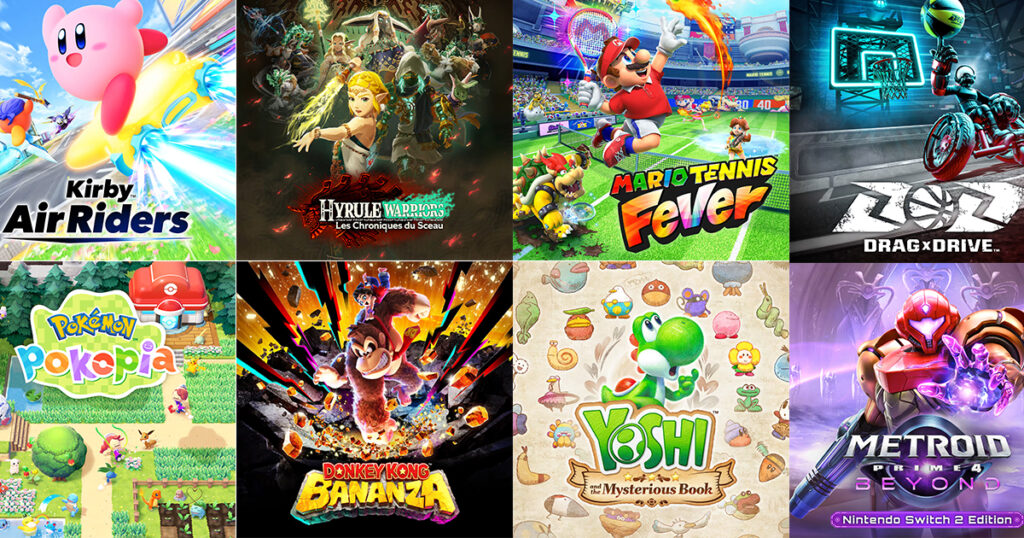
Nintendo gradually began to install several strong exclusives capable of giving the console a real identity.
Donkey Kong Bananza It quickly established itself as one of the biggest surprises of the first year. The first truly major 3D return of Donkey Kong in a very long time, the game focuses on massively destructible environments, much more ambitious exploration, and a formula that at times recalls the creative spirit of a Super Mario Odyssey. For many players, this is simply one of the first true system sellers of the Switch 2.
On the Nintendo side and with the Pokémon license, the year has also taken on a new dimension. Pokémon Legends: ZA This naturally constitutes a major event for the current Nintendo ecosystem, but the real recent surprise is probably Pokémon Pokopia.
The machine's latest major exclusive feature, Pokémon Pokopia It takes a much more original approach than traditional Pokémon RPGs. Here, the game blends life simulation, management, cooperation, and the building of Pokémon habitats in a world that is gradually developed. The commercial reception seems particularly strong: the title has quickly risen to become one of the platform's top-selling games.
Nintendo also continued to power its machine with Kirby Air Riders, The return of a cult franchise helmed by Masahiro Sakurai. Blending racing, action, and arcade-style gameplay, the game brings a fresh flavor to the exclusive catalog and speaks directly to a significant portion of the Nintendo audience.
The same observation applies to Zelda with Hyrule Warriors: Age of Imprisonment, which extends the universe of Tears of the Kingdom in a more spectacular musou style and gives the Switch 2 a strong new action-oriented exclusive.
Finally, several players also keep an eye on more recent releases and announcements such as Yoshi and the Mysterious Book, which gradually contribute to strengthening the console's software identity.
In other words: almost a year after its launch, the Switch 2 is no longer solely reliant on Mario Kart World. The console is finally starting to build a more credible and varied library of exclusives.
Technically, the leap from the Switch 1 is clearly visible
In terms of hardware, the difference with the first Switch is much more obvious.
There Nintendo Switch 1, Released in 2017, it relied on an NVIDIA Tegra X1 chip that gradually showed its limitations over the years. Modest resolutions, significant graphical compromises, sometimes unstable framerates, and longer loading times were commonplace in many demanding games.
The Switch 2 significantly improves the situation. The new, much more modern NVIDIA architecture delivers considerably more CPU and GPU power. Loading times are faster, resolutions are higher, overall performance is improved, and several modern technologies are finally integrated.
One of the most interesting topics remains, of course, DLSS. Thanks to NVIDIA's upscaling technologies, the console can produce a more visually ambitious image without requiring the raw power of its high-end home console competitors. This allows Nintendo to achieve a particularly appealing balance between portability, energy efficiency, and visual quality.
In practical terms, the Switch 2 is no longer in the same technical category as the Switch 1.
How does the Switch 2 compare to other consoles?
The comparison becomes more nuanced when the machine is placed in comparison to other market players.
Facing the Switch 1, The generational leap is obvious. The new machine is more modern, smoother, more comfortable, and significantly better equipped to handle current production demands.
Facing Steam Deck, The discussion becomes more interesting. Valve retains several important advantages: an open PC ecosystem, a vast Steam library, mods, advanced settings, and overall versatility. But Nintendo retains strengths that are very difficult to replicate elsewhere: ease of use, immediate console experience, first-party optimization, and a catalog of exclusive titles.
Facing a PlayStation 5 or a Xbox Series X, Let's be honest: the Switch 2 isn't trying to win the raw power battle. Sony and Microsoft still have the edge in several areas, including GPU power, certain ray tracing capabilities, native resolution, and pure performance on the most demanding games.
Nintendo is playing a different card. The proposition still relies on the hybrid format, mobility, first-party exclusives and a more accessible approach to video games.
So, was it worth buying the Switch 2?
Almost a year after its launch, the answer still depends a lot on the player's profile.
For an audience already deeply attached to the Nintendo universe, the console seems much easier to recommend today than at the time of its release. The game library is starting to take shape, the technology has improved significantly compared to the original Switch, and the hybrid experience remains extremely appealing.
For gamers more focused on raw power, big AAA multi-platform games or the PC ecosystem, the purchase may seem even less obvious, especially if a PS5, an Xbox Series X or a gaming PC already occupies the living room.
But one thing seems quite clear today: the Switch 2 looks less and less like a slightly improved Switch. Almost a year after its launch, Nintendo has begun to show that its new generation does indeed possess its own identity, provided you embrace the brand's particular philosophy.