

For a long time, spending €600 to €700 on a high-end smartphone already seemed like a significant amount. Today, the situation has clearly changed. Between premium models that are flirting with the 1200 €, 1500 €, or even more for some foldable phones, many users are now asking themselves the same question: why do smartphones cost so much in 2026?
Simple inflation, technological explosion, or a deliberate strategy by manufacturers? The reality lies somewhere between all these elements.
Smartphones today incorporate an impressive amount of technology
A modern smartphone is no longer simply a phone equipped with a touchscreen.
By 2026, a flagship phone concentrates a massive amount of advanced components: extremely powerful processor, several sophisticated photo sensors, high-brightness OLED screens, ultra-fast charging batteries, internal cooling, embedded AI, advanced network modules, biometrics, fast storage and sometimes even complex hinges on foldable models.
Each generation gradually adds new technological building blocks.
Current devices, for example, incorporate highly advanced chips manufactured using very expensive processes. The next generations of 2nm SoCs represent colossal industrial investments for companies like Apple, Qualcomm, Samsung, and MediaTek.
In other words: modern smartphones are increasingly resembling true premium mini-computers… with a hardware cost that naturally follows the same trajectory.
Artificial intelligence also contributes to rising prices
It is impossible to talk about the mobile market in 2026 without mentioning artificial intelligence.
Apple is pushing Apple Intelligence, Google is accelerating sharply around Gemini and Android, Samsung continues to integrate massively Galaxy AI in its premium devices.
But integrating AI directly into a smartphone also requires more hardware resources.
Several components gradually become more important:
- AI-dedicated NPUs
- higher RAM
- increased storage
- processors capable of performing more calculations locally
Some modern AI functions simply require more power, more RAM, and greater processing capacity.
As a result, manufacturers continually reinforce the hardware… which inevitably ends up impacting the final price.
Mobile photography is becoming increasingly expensive for manufacturers.
The camera sector also represents a huge part of the budget for a modern smartphone.
The era of the single sensor is long gone. Premium models now boast multiple sophisticated modules: ultra-wide-angle, periscope telephoto, advanced optical zoom, high-resolution sensors, complex stabilization, and AI-enhanced software processing.
Manufacturers are investing heavily in this area because it is one of the main marketing arguments in the mobile market.
Developing these systems is expensive.
Sensors are getting bigger, optics are becoming more complex, image processing algorithms are consuming more computing power, and technical partnerships — such as Leica, Zeiss or Hasselblad depending on the brand — add yet another layer of cost.
Manufacturers are deliberately pushing the market towards premium products.
The price increase cannot be explained solely by technology.
Business strategies also play an important role.
The smartphone market is maturing more each year. Many users now keep their phones longer than before, sometimes four, five or six years.
For manufacturers, selling less often requires a different approach: increasing the average value of each device sold.
For several years, Apple, Samsung, Google and other premium brands have been gradually reinforcing this trend.
More Ultra models, more Pro versions, more high storage options… manufacturers are clearly pushing the market towards the high end.
The €1000 smartphone has gradually become the new normal in the premium segment.
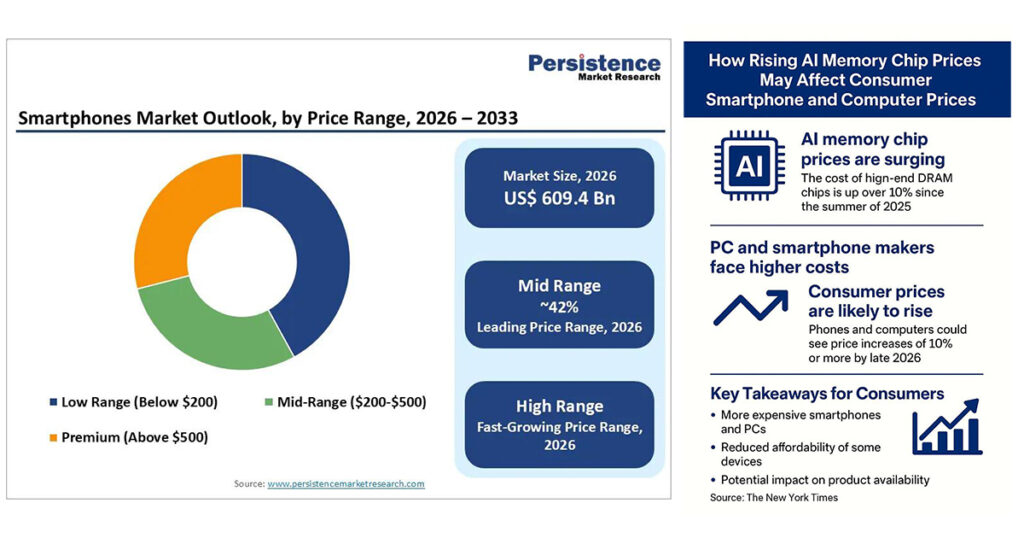
Inflation, raw materials, and global production also complicate the equation.
Obviously, manufacturers don't control everything.
Global manufacturing remains subject to several economic pressures: energy costs, international logistics, electronic components, specialized materials, and extremely complex industrial capacities.
Producing a modern smartphone today involves a sophisticated global supply chain involving many different suppliers.
Even a relatively small variation in the cost of certain components can end up having a significant impact on the final price of a device sold on a large scale.
Do you really need to spend more than €1000 on a smartphone in 2026?
The question deserves to be asked.
Because while premium smartphones are becoming more technically impressive, the mid-range market is also progressing extremely quickly.
Today, several devices located between 400 and 700 € already offer:
- high-quality OLED screens
- excellent performance
- very good photos
- solid autonomy
- long update periods
In other words, modern high-end products often offer more refinement, versatility or innovation… but not necessarily a difference in use proportional to the price difference for all users.
Conclusion
If smartphones become so expensive in 2026, it's not due to a single cause. The explosion in performance, the massive arrival of artificial intelligence, the increasing sophistication of camera modules, industrial costs, and manufacturers' premium strategies all contribute to driving prices up.
The good news is that this move upmarket doesn't automatically make the more affordable models obsolete. The mid-range has never been so capable.
But one thing now seems clear: the modern premium smartphone is no longer just aiming to be a high-performing phone. It is gradually trying to become a true miniature personal computer… with a price tag that reflects this ambition.